


Moving to Fairfield County
from New York City
A Local’s Guide
Many people begin this process in the wrong order. They start with houses — saved searches, open houses on a Saturday, a spreadsheet of listings — and only later work out what the commute actually looks like, how property taxes work, how far your dollar goes from one town to the next and what local amenities are important to them.
The buyers who are happiest long term do it the other way around. They figure these things out first and then move on to the house. I’ve covered this before, but not in this level of detail and it is worth sharing.
That is what this guide is for. I have lived in Fairfield my whole life and spent more than fifteen years helping people move here. This is the conversation I have with them before we look at a single property.
Start with the train, because the train decides everything
For almost every family moving out of the city, the commute is a major constraint. It determines which towns are realistic, which neighborhoods within those towns are realistic, and how much house the remaining budget will buy.
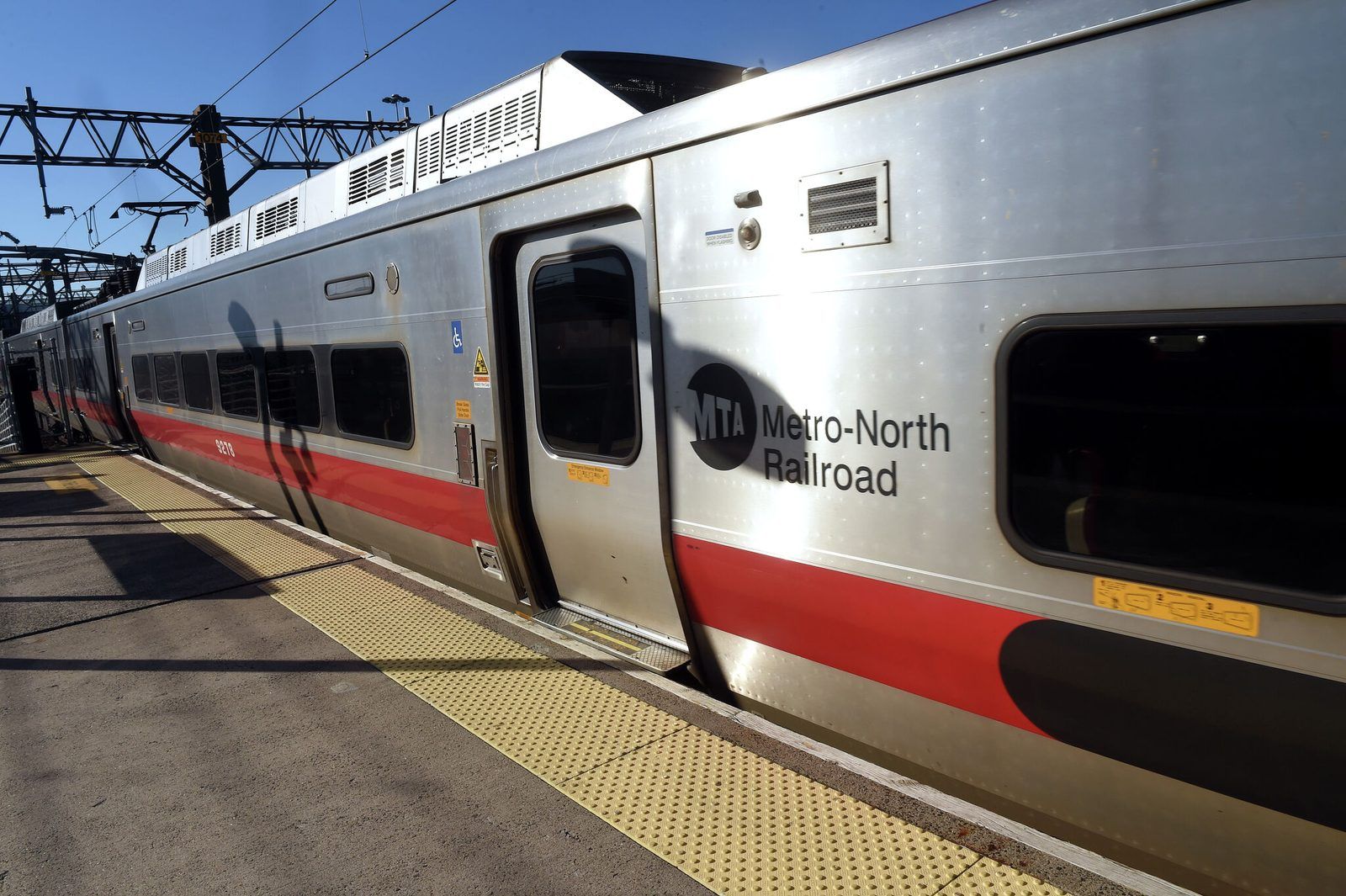
Fairfield County sits on Metro-North's New Haven Line. Typical travel times to Grand Central:
- Greenwich
- approximately 50 to 60 minutes
- Stamford
- approximately 50 to 65 minutes
- Darien
- approximately 60 to 70 minutes
- Westport
- approximately 70 to 80 minutes
- Fairfield
- approximately 75 to 90 minutes
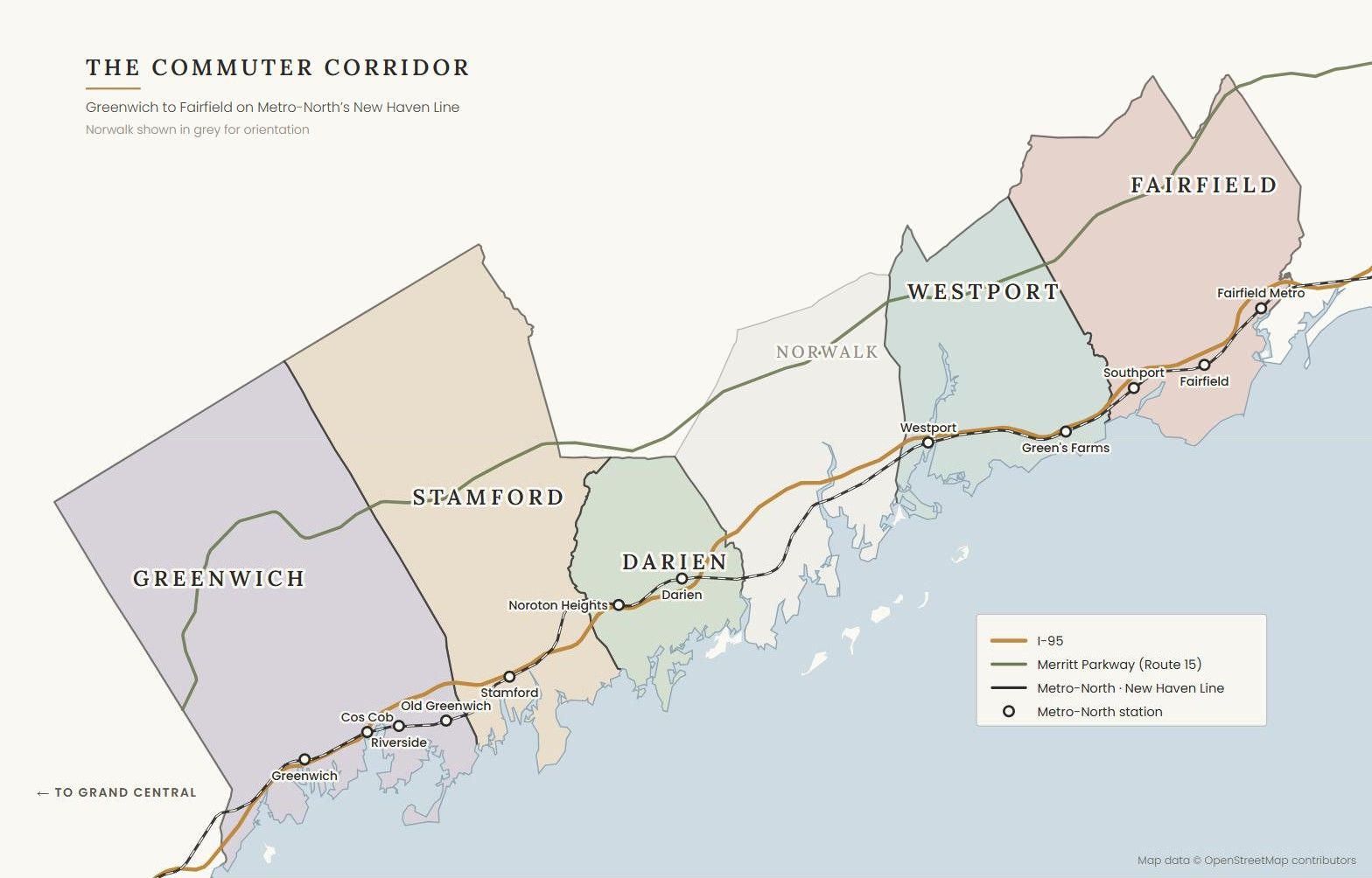
Those ranges seem simple, but the commute is more complicated than that. First, what station within each market will you call home? Every town in the list above except Stamford, has multiple stations on the main New Haven line. Fairfield has three, Westport two, Darien two and Greenwich four. But not all stations are created equal. Only Fairfield offers two stations with a full schedule and express trains. The other towns have only one primary station, with the additional stations being largely slower local trains.
Second, you don’t live at the station house, so that means your commute starts when you leave your driveway and hopefully ends around Grand Central Station. For example, let’s say you live somewhere in Backcountry Greenwich, north of the Merritt Parkway. Your shortest drive to the Greenwich train station is 15 minutes and that assumes no traffic, school buses or landscaping trucks. So that 50 minute express train could easily be 75 minutes once you factor in the drive, parking, walking and building in enough cushion for the unknown.
On the opposite side of that, let’s take a neighborhood like Fairfield Beach or University in the Town of Fairfield. Many of these homes could walk to Fairfield Station in 15 minutes, but driving is certainly five minutes or less. Parking is a surface lot, so no garage to traverse. So that 75 minute express train is an 85 minute commute. Still 10 minutes longer than Greenwich, but not the 25 minutes you would think going off the train schedule.
Parking does deserve its own sentence. Several stations have multi-year waiting lists for permits. You should confirm that with the town before assuming parking is available. Here is a link to the Town of Fairfield’s page to check parking pass availability.
The five towns, honestly
Every town here markets itself as the perfect balance of everything. They are not the same, and the differences are the entire point.
Greenwich is the closest to the city and the most established. Multiple stations, expansive properties, a downtown with real retail, and the shortest commute in the county. It carries the highest price point in Connecticut and attracts buyers who want proximity to Manhattan without living in it.
Stamford is the urban option. It is a genuine business hub with the most frequent express service in the county, plus apartment buildings, waterfront residences, restaurants, and nightlife. If leaving the city entirely feels like too much, Stamford is the compromise that usually works — you keep density and walkability and still get the tax and space arbitrage.
Darien has one of the most efficient commutes in the county and a quiet, traditional residential character. A well-loved town center, waterfront parks, strong community. Buyers who choose Darien are usually optimizing for the train and for a settled New England feel.
Westport is the design-forward one. Efficient train access, an arts scene, beaches, and housing stock with real architectural interest. It is where buyers land when they want the commute to work but do not want their daily life to feel suburban in the generic sense.
Fairfield is the one I know best, and the most balanced. Three Metro-North stations, which means more of the town is within a short drive of a train. Miles of coastline, a real downtown, two universities, and housing that ranges from beach cottages to country estates. The train ride is the longest of the five, but as I illustrated above, the train isn’t the entire commute.
Where this all sits
The corridor, from Greenwich to Fairfield
Five towns, one rail line, two highways. Everything in this guide comes back to this picture — where a town sits on the New Haven Line, how many stations it has, and how far you actually are from one of them.
Property taxes work differently here
This is the part almost nobody researches before they start looking, and it is where the surprises live.
Property taxes work on a formula, not a rate you can eyeball. Connecticut assesses property at 70% of market value, then applies the town's mill rate to that assessed figure. So a home with a $1,000,000 market value is assessed at $700,000, and the mill rate applies to that.
Here is the part that catches people: a lower mill rate does not mean a lower tax bill (see below table). Towns with very low mill rates often have very high assessed values, and the bill is the product of the two. Comparing mill rates between towns without comparing assessments tells you almost nothing.
Mill rates are also set annually and several Fairfield County towns are in the middle of revaluation, so any number you find online may already be out of date. Check the current figure with the town assessor for the specific property you are considering, not the town average.
| Rank on taxes paid | Town | Median sale price | Effective rate | Tax on median home | Mill rate | Assessments dated |
|---|---|---|---|---|---|---|
| 1 (highest) | Darien | $3.0MM | ~0.95% | ~$28,100 | 16.05 | Oct 1, 2023 |
| 2 | Westport | $2.4MM | ~0.88% | ~$21,200 | 13.20 | Oct 1, 2025 |
| 3 | Greenwich | $2.6MM | ~0.68% | ~$17,700 | 10.124 | Oct 1, 2025 |
| 4 | Fairfield | $1.2MM | ~1.28% | ~$15,000 | 19.19 | Oct 1, 2025 |
| 5 (lowest) | Stamford | $1.0MM | ~1.36–1.41% | ~$13,600 | 24.31–25.14 | Oct 1, 2022 |
Median sale price: SmartMLS 2026 YTD through July 31, 2026, single-family home sales.
What your budget actually buys
Similar to comparing neighborhoods in New York City, pricing can vary greatly across Fairfield County.
The short version: Comparing 2026 single family home median sales price data through July 31, $1.2MM in Fairfield compared to $1.0MM in Stamford, $2.4MM in Westport, $3.0MM in Darien and $2.6MM in Greenwich.
The practical implication for a relocating buyer: decide whether you are optimizing for commute or for house, because at most budgets you cannot fully optimize for both.
How Connecticut is mechanically different
Every state has its own laws, fees and customs when it comes to purchasing real estate and Connecticut is no different.
Connecticut closings involve an attorney. This is different from many states and from a typical New York co-op or condo transaction. Legal representation is standard here and it is a real line item in your closing costs. I have a lot of experience and a great network here, so if you don’t have an attorney in mind, I have some great referrals.
Budget 3 to 4% of the purchase price for buyer-side closing costs, on top of your down payment. In Connecticut that typically includes attorney fees in the range of $1,500 to $2,500, an appraisal around $500 to $800, an inspection $600 to $1,200, lender fees of roughly $1,000 to $1,500, title insurance commonly calculated at $3 per $1,000 borrowed, and recording fees of about $375. I cover the whole picture in the Fairfield County home buyer's guide.
Insurance is not a formality here. Premiums vary meaningfully by property type, age, and location, and a coastal property carries a different risk profile than one two miles inland. Flood zones matter in the shoreline neighborhoods, and they affect both your premium and your financing. Find out where a property sits before you write an offer, not during attorney review.

The tax question to take to a CPA
Income tax is often the largest financial factor in this move, and it is the one I will not advise you on.
If you are moving out of New York City and continuing to work there, your state and city income tax situation changes in ways that depend on where you work, how many days you work there, whether your employer withholds correctly, and how residency is determined. The interaction between New York and Connecticut tax rules is genuinely complicated, the published guidance online is inconsistent, and getting it wrong is expensive.
Talk to a CPA who handles New York and Connecticut returns before you commit to a move date. I am a Realtor, not a tax advisor, and this is one of the few parts of a relocation where the right answer is a professional who does only this. I am happy to point you toward people my clients have worked with.
A realistic timeline
Most people underestimate this, usually by a few months.
Six to twelve months out. Start riding the train. Not on a Saturday — on a weekday, at the hour you would actually travel, from a station you are considering. Nothing else tells you as much. Visit towns on a weekday morning and a Sunday afternoon; they feel like different places.
Three to six months out. Get pre-approved with a lender who understands Connecticut transactions. I work with some great local lenders and can help you find the right one if you plan to finance your home purchase. Make sure you’ve had your income tax conversation by now. Lastly, you should really narrow to two towns rather than five — at some point breadth stops being research and starts being an obstacle.
Two to three months out. This is when serious searching pays off. Take this time to narrow down your shortlist to specific neighborhoods within the town(s) you selected. This Fairfield guide can help accelerate that process. If you are selling first, this is also when your current home needs to be positioned, and the two timelines have to be planned together rather than sequentially.
Under 60 days. Possible, and I have done it, but it narrows what you can be selective about. Inventory in the towns above is limited, and the right house does not always appear on demand.
What nobody tells you about the move itself
Inventory is tighter than you expect. People here tend to stay. That means fewer homes on the market than a buyer coming from a city market anticipates, and it means the right property is worth moving on quickly when it appears.
Off-market matters more here than it does in the city. A meaningful share of transactions in these towns happen before anything reaches the MLS. If you are only watching public listings, you are seeing part of the market.
The school-district question is more complicated than a ranking. Districts, boundaries, and specific school assignments vary within towns, sometimes street by street. If schools factor into your decision, verify the assignment for the specific address with the district directly. Do not rely on a listing, a website, or on me — assignments change, and it is too important to take secondhand.
Selling and buying simultaneously is the hardest version of this. It is also the most common version. Timing two closings across two states, with two sets of rules and two attorneys, is where most of the stress in a relocation actually lives. It is worth planning months before you think you need to.
The move is not really about the house
The house is the easy part. What determines whether this move works is everything around it — the train you will ride two thousand times, the town that fits how you actually live rather than how you imagine you will, the specific neighborhood and how well it integrates and enhances your family’s lives and the financial picture nobody explained to you before you started.
Get those right and the house follows.
If you are considering a move to Fairfield County, I would be glad to talk it through all of this. I’ve spent almost my entire life here. Many of the buyers I work with start this conversation six months or more before they are ready…you can’t be too early.
— Shoshana Snyder, Homes by Shoshana

Shoshana Snyder
Realtor® · Compass Connecticut
I have lived in Fairfield my whole life and spent more than fifteen years helping people buy and sell across Fairfield County. I am also an active investor and advise builders on new construction, which is usually why relocating buyers end up talking to me about numbers before they talk to me about houses.
- 2026 RealTrends Verified · Top 1.5% Nationwide
- Top 5 Individual Agent · Fairfield Home Sales (2025)
- $335M+ Career Sales
Common questions
Relocating to Fairfield County
How long is the commute to Grand Central, really?
The published ride is 50 to 60 minutes from Greenwich and 75 to 90 from Fairfield, but the train is not the whole commute. Door to door, add the drive to the station, parking and the walk at both ends. A Backcountry Greenwich house with a 15-minute drive can turn a 50-minute express into 75 minutes; a Fairfield Beach house five minutes from a surface lot turns a 75-minute express into about 85. The gap between the two towns is much smaller in practice than the timetable suggests.
Do I need a lawyer to buy a house in Connecticut?
Yes. Connecticut closings involve an attorney, which is different from many states and from a typical New York co-op or condo transaction. It is standard here and it is a real line item in your closing costs — typically $1,500 to $2,500. If you do not have someone in mind, I am happy to make referrals.
Which of these towns has the lowest property taxes?
Not the one with the lowest mill rate. Connecticut assesses at 70% of market value and applies the town’s mill rate to that figure, so the bill is the product of two numbers rather than one. On a median-priced single-family home, Stamford currently produces the smallest annual bill and Darien the largest — and Stamford has the highest mill rate of the five. Mill rates are reset annually and several towns are mid-revaluation, so confirm the current figure with the assessor for the specific property.
How far ahead should I start?
Six to twelve months is realistic, and most people underestimate it by a few months. That window is for riding the train on a weekday at the hour you would actually travel, visiting towns on both a weekday morning and a Sunday afternoon, and having the income-tax conversation with a CPA. Under 60 days is possible — I have done it — but it narrows what you can be selective about.
Why is there so little on the market?
People here tend to stay, so inventory runs tighter than a buyer coming from a city market expects. A meaningful share of transactions in these towns also happen before anything reaches the MLS. If you are only watching public listings, you are seeing part of the market.
What should I budget for closing costs in Connecticut?
Three to four percent of the purchase price, on top of your down payment. Connecticut closings involve an attorney, which is a real line item rather than a formality — typically $1,500 to $2,500. The remainder is an appraisal at $500 to $800, an inspection at $600 to $1,200, lender fees of roughly $1,000 to $1,500, title insurance commonly calculated at $3 per $1,000 borrowed, and recording fees of about $375.
What is the median sale price in each of these towns?
Through July 2026, single-family medians run from $1.0 million in Stamford and $1.2 million in Fairfield to $2.4 million in Westport, $2.6 million in Greenwich and $3.0 million in Darien. That spread is the whole decision: at most budgets you cannot optimize for both commute and house, so it is worth knowing which one you are actually buying. Figures are SmartMLS 2026 year to date through 31 July 2026.
Last reviewed September 2026